Feature · Part of The Years Collection
The Craft Behind Yearbook
Ben Ringel built a daily nostalgia puzzle as a vehicle for his own curiosity. It turned out a lot of other people were curious too.
 By Craig Dugas · · 10 min read
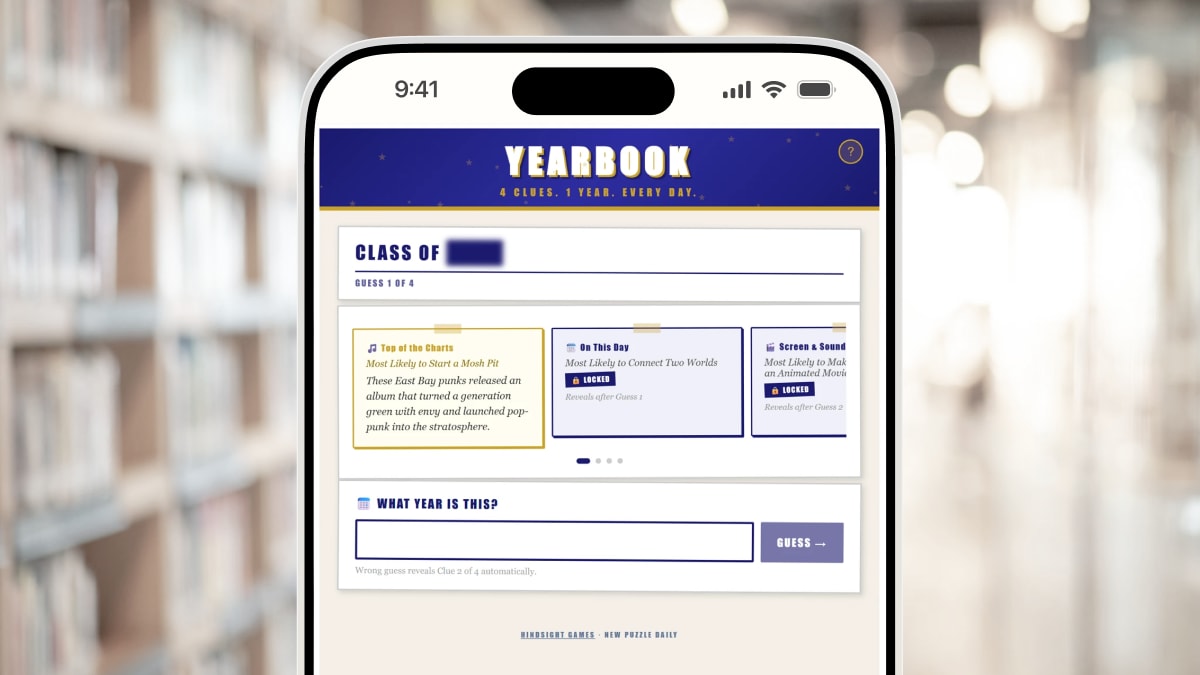
There’s a kind of daily game that feels less like a puzzle and more like a small invitation to go down a rabbit hole. You play it, you get your score, and then, if it’s done right, you find yourself five Wikipedia tabs deep.
Yearbook, the year-guessing game from Ben Ringel of Hindsight Games, is one of those. Each puzzle gives you four clues from a single year between 1950 and 2025, and asks you to guess the exact year it happened. The mechanics are simple. The trick is in everything around them: the clues, the way your score becomes a “grade”, the scholastic colors. It’s a game built with a well-rounded hand.
The story behind Yearbook is just as compelling as the game itself. Ben built it, in his own words, “selfishly,” as a way to gamify the kind of Wikipedia wandering he already enjoyed. The fact that a lot of other people turned out to want the same thing is kind of the point of the whole project.
Developer, trivia enthusiast, and Founder of Hindsight Games. Builds daily games as a way to deepen his own curiosity about history, sports, and pop culture.


In conversation with Ben
Where did Yearbook come from?
I’ve always enjoyed playing daily games and dabbling in programming, so the idea just came to me after a recent Connections puzzle that maybe my next hobby project could be a daily game. I like trivia and diving deeper into history, so I selfishly viewed this as a way to gamify finding random, interesting Wikipedia articles for myself and other like-minded people.
It’s interesting to read the articles for each game’s events afterward, and that’s one of my favorite parts of the game. I’ve really enjoyed learning more about events that happened when I was younger and didn’t fully realize how impactful they truly were as a kid.
The name “Yearbook” is doing a lot of work. It nails the nostalgia angle without needing much explanation. Was that the working title from day one, or did it land later?
Once I settled on the mechanics of the game, Yearbook was always the name. It just fits; I hope players get that dose of nostalgia remembering some of these events that they might also get when going back through an old yearbook.
I selfishly viewed this as a way to gamify finding random, interesting Wikipedia articles for myself and other like-minded people.
Year-guessing as a mechanic exists in a few games now (Timeguessr, Yeardle, etc.). What did you want Yearbook to do that the others weren’t? And how did the scholastic look come together?
Those other games are great. I realized that at this point in the daily game lifecycle there are very few truly “original” arenas. Words, movies, brands, history, sports have all been done by a million creative developers. My goal wasn’t necessarily to be the first history or guess-the-year game, but to stand out on cohesion and fun-factor of the theme, as well as being a vehicle for going down a rabbit-hole of learning more.
A big part of why I made this was to be able to learn more about history myself, so linking out to Wikipedia for each clue is a core piece of the game to me.
The Yearbook theme hopefully sets the game apart too, from your score being a “grade” to the superlatives on the clues to the scholastic colors. I want as many aspects of the experience as possible to keep the player immersed in that nostalgic theme.
What kind of player feedback has stuck with you?
This was my first time making a game, so it’s been a learning experience. One of the main things was feedback from initial players around calibrating difficulty and scoring. It takes a fine balance between something being too easy to be fun and too hard where it switches from challenging to punishing.
I’ve also really appreciated the understanding attitude of players. There was one day where one of the clues referenced a different year than the other three, and a player reached out with a nice message to give me a heads up and then replied with gratitude once I let them know I’d fixed the error. It meant a lot that someone I’ve never met gave constructive feedback in such a polite way, and told me how much they enjoy playing the game I’ve built.
Nostalgia is tricky, too obscure and people feel left out, too obvious and it’s boring. How do you calibrate that?
I try to make sure each puzzle has a mix of more obvious and more obscure clues. And with the range of potential answers (1950–2025), some days are naturally going to reference events that happened before certain players were born, or more recent trends that not all players are up to date on.
My hope is that the players come to Yearbook because they want that mix of learning new pieces of knowledge as well as re-living some events they know well. Every puzzle will hit differently for every player. One puzzle had a clue about the first Spider-Man movie coming out, and I vividly remember seeing and discussing that when it premiered. What might seem like an obscure clue to someone else was instantly obvious to me and brought me back to that point in my life.
I realized that at this point in the daily game lifecycle there are very few truly “original” arenas. Words, movies, brands, history, sports have all been done by a million creative developers.
What else have you made or are you working on now?
I have another game out called Rough Draft, which is a mix of sports and pop culture. I’m also planning on making something related to current events and news stories, though nothing’s concrete yet. In a similar vein to Yearbook, part of that is selfish as I’m hoping it can help me keep up with the news and be more worldly each day.
Are there any other daily games you find yourself playing, or that have inspired you?
The big ones have been Wordle, Connections, and Immaculate Grid. Not exactly a daily game, but I LOVED Sporcle back in the day. The fact that there was a seemingly endless supply of ways to test my knowledge and learn more about things I cared about just blew me away.
If someone’s playing Yearbook for the first time today, what do you hope they walk away with beyond a score?
Truly, I hope everyone who plays gets one of those “oh I remember that” or “wow I can’t believe that happened 20 years ago” hits of nostalgia, and that they learn something new each day. I really do encourage clicking the “learn more” links after the game. I almost always learn something interesting, even about events I’ve lived through.
There’s something generous about a game built first for its own maker. It means the design choices weren’t solely made for retention curves or share rates. They were driven by what Ben actually wanted out of the experience: a creative way to gamify learning. The Wikipedia links matter because Ben wants to click them. The scholastic-inspired color palette matters because the theme matters to him.
What you end up with is a game where the mechanics, the theme, and the chance to learn something new come together as one experience. If you’ve got five minutes today, give it a play. Then click the Wikipedia links.