🧩 Minute Cryptic Answers & Hints (Non-Spoiler)
Minute Cryptic is a daily cryptic clue game where you solve one clue a day using wordplay, definition spotting, and pattern recognition.
Jump to: Hints ↗ · Strategy ↗ · FAQ ↗
Looking for Minute Cryptic answers or today's clue help? You're in the right place, but we don’t spoil the solution.
Instead, this page gives you smart nudges, classic cryptic-solving tricks, and approachable ways to think through today’s Minute Cryptic without ruining the fun.
🎮 Play today's Minute Cryptic →
New puzzle every day • Free to play • No signup
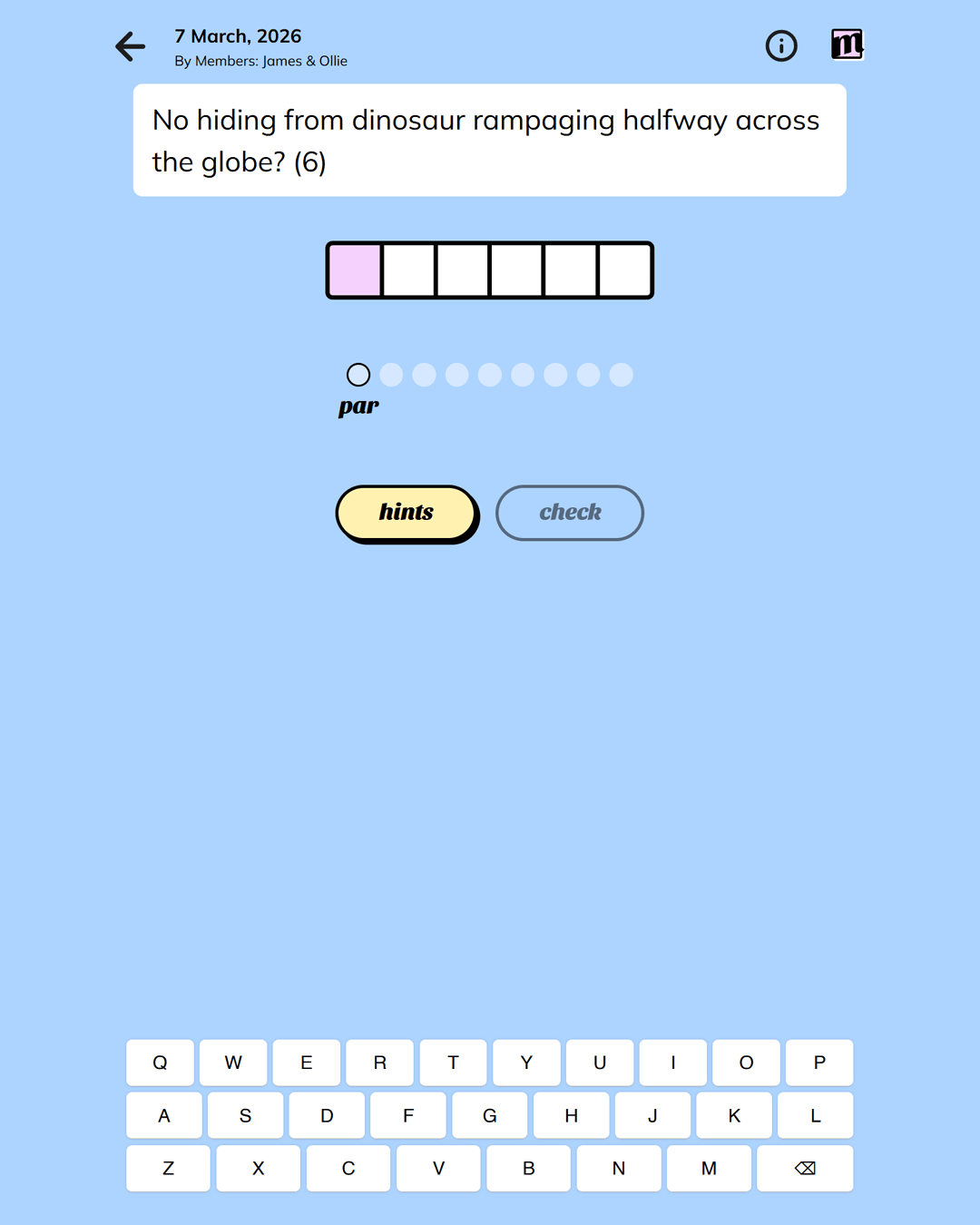 Example Minute Cryptic interface (illustration only, not today’s answer).
A Better Way to Think About Minute Cryptic
Cryptic clues can feel impossible until they suddenly don’t.
That’s because a cryptic clue is usually not one clue. It’s really two clues hiding in one sentence:
- a definition
- and a wordplay recipe
The trick is learning to split the clue apart.
🧠 Mindset Shift
- Don’t ask, “Why don’t I get this?”
- Ask, “Which part is the definition, and which part is the construction?”
- You are not guessing randomly. You are decoding.
And yes, even if you’re brand new, you can absolutely get better at this.
What Makes Minute Cryptic Different?
Minute Cryptic is built to make cryptics feel more approachable than the old-school, newspaper-crossword kind.
That means if you’re stuck, you’re not failing. You’re doing the actual thing the game is designed around:
- noticing patterns
- learning clue structures
- building confidence over time
So if you came here looking for today’s Minute Cryptic answer, the best Playlin-style help is this:
Don’t rush to brute force it.
First, identify the likely definition.
Then look for clue mechanics.
That one habit alone will make you much better.
Hints for Minute Cryptic (Without Spoilers)
Here are the most useful ways to get traction on today’s clue without giving away the answer.
1. Start with the answer length
The number in parentheses is huge.
If the clue ends in (6), you’re looking for a 6-letter answer. That helps you:
- reject almost-right ideas quickly
- test synonym candidates
- spot hidden answers or anagrams with the right length
A beautiful answer that’s the wrong length is not the answer.
2. The definition is often at one end
In many cryptic clues, the definition is either:
- at the beginning
- or at the end
So if the clue is something like:
No hiding from dinosaur rampaging halfway across the globe? (6)
A strong first move is to ask:
- Is “No hiding from” the definition?
- Or is “halfway across the globe?” the definition?
You usually won’t know immediately, but trying both ends gives you structure.
3. Suspicious words are often doing cryptic work
In everyday language, a clue reads like a sentence.
In cryptic language, certain words may be signals that tell you to do something with letters.
Common possibilities include:
- anagram indicators: broken, mixed, wild, rampaging, crazy, oddly
- hidden indicators: in, inside, part of, some of, hiding
- reversal indicators: back, returned, reversed, coming up
- selector indicators: first, last, halfway, heart of, initially
- container indicators: around, holding, inside, swallowing
So a word like “rampaging” often deserves extra suspicion. It may be telling you to rearrange letters.
4. “Halfway,” “middle,” and “heart” often point to letter selection
If a clue says:
- halfway
- middle
- heart of
- center of
…it may be asking you to take middle letters from a word.
That doesn’t always mean literally half the clue. It usually means:
- take the middle letter(s) of a specific word
- or extract a central chunk
5. Question marks matter
If the clue ends with a ?, that often signals a more playful or indirect reading.
That can mean:
- the definition is whimsical
- the surface meaning is misleading on purpose
- there may be a pun, joke, or looser phrase involved
Don’t ignore the question mark. It’s often permission for the clue to get cheeky.
How to Think Through a Minute Cryptic Clue
When you’re stuck, use this process.
Step 1: Mark the likely definition
Try the first few words and the last few words as candidate definitions.
Ask:
- What could reasonably define a single word or phrase of this length?
- Which end feels more “dictionary-like”?
Step 2: Hunt for an indicator
Look for words suggesting:
- rearrange
- hide
- reverse
- take first letters
- take middle letters
- insert one thing into another
- remove letters
This often unlocks the clue type.
Step 3: Identify the fodder
Once you suspect the clue type, ask:
Which letters am I supposed to manipulate?
That letter material is often called the fodder.
Example thought process:
- “Rampaging” might mean anagram
- So what letters are being rampaged?
- “Dinosaur” maybe?
- Or part of a nearby word group?
Even if that guess is wrong, it’s the right style of thinking.
Step 4: Test against the definition
When you get a candidate answer, don’t stop at “that fits.”
Check all three:
- Does it match the letter count?
- Does the wordplay justify it?
- Does it satisfy the definition cleanly?
A true cryptic answer usually clicks in both directions.
The Most Common Cryptic Moves to Watch For
You do not need to memorize every clue type on day one. But these are the big ones.
Anagrams
One set of letters gets rearranged.
Common signals: mixed, wild, broken, crazy, rampaging, oddly, badly
What to ask:
- Which nearby letters are being scrambled?
- Do they make a word of the required length?
Hidden answers
The answer is hiding directly inside the clue text.
Common signals: in, inside, some of, part of, hiding, among
What to ask:
- Is there a clean 4-, 5-, or 6-letter word sitting across word boundaries?
- Am I overlooking something obvious in the clue itself?
Reversals
A set of letters gets flipped backwards.
Common signals: back, returned, reversed, coming up
What to ask:
- Is there a short chunk that becomes a word when reversed?
Selectors
You take first letters, last letters, middle letters, odds, evens, etc.
Common signals: initially, first, at first, finally, ends of, heart of, halfway, oddly, evenly
What to ask:
- Which letters am I being told to select?
- Is it initials, middles, or alternating letters?
Containers
One piece goes inside another.
Common signals: in, inside, around, holding, swallowing, containing
What to ask:
- What’s the outside piece?
- What’s being inserted?
Deletions
You remove one or more letters.
Common signals: without, dropping, losing, endless, topless, heartless
What to ask:
- Which letters get removed?
- Does the remaining chunk make sense?
How to Nudge Yourself on Any Clue
Without giving away today’s answer, here’s the kind of thinking that may help on a clue like the one shown:
- One word in the clue strongly suggests letter manipulation
- Another word may suggest taking a middle section
- The clue likely wants you to separate the surface story from the actual mechanism
- The answer is probably not reached by pure synonym alone
So if today’s clue feels impossible, try this:
Write the clue out and circle any words that could be indicators.
Then underline the most likely definition at one end.
That small reset often breaks the freeze.
When You’re Completely Stuck
Here’s the order I’d recommend:
1. Stop rereading the clue as a normal sentence
That’s the trap.
Cryptic clues are designed to sound natural while hiding instructions.
2. Look for the “doing word”
Which word is telling you to act on letters?
Often that’s where the puzzle opens up.
3. Try the opposite end as the definition
If you’ve been assuming the definition is at the front, switch and test the back.
4. Use the game’s hint system
Minute Cryptic includes hints for a reason.
Using a hint is not “cheating.” It’s training.
A good hint teaches you how the clue works, not just what the answer is.
Quick Strategy Boosters
Don’t solve it like a normal crossword
In a normal crossword, the clue points more directly at the answer.
In a cryptic, the clue often tells you how to build the answer.
That’s a different muscle.
Learn indicator words by repetition
You do not need a giant list.
Just start noticing repeats:
- anagram-ish words
- hidden-answer words
- middle-letter words
- insertion words
After a week or two, patterns jump out faster.
Tiny wins matter
Even correctly identifying:
- the definition
- the clue type
- or the fodder
…is real progress, even before you get the final answer.
That’s how cryptic skill grows.
Get Better at Minute Cryptic
You can absolutely improve at cryptics with steady exposure.
1. Play daily
Daily repetition matters more than marathon solving.
A single clue per day is enough to build pattern recognition over time.
2. Learn the “language” of cryptics
Cryptic crosswords have recurring conventions. The more you see them, the less mysterious they feel.
3. Review how the clue worked after solving
The biggest improvement comes after the solve.
Ask:
- What was the definition?
- What was the indicator?
- What letters were manipulated?
- Why was that fair?
That reflection turns each puzzle into training.
More Games Like Minute Cryptic
If you like clever wordplay, deduction, and daily “aha!” moments, try these too:
| Game | Why You'll Love It |
|---|---|
| 🧠 Circuits | Make connected compound terms by finding the right linking words. |
| 📝 Wordle | Daily word deduction with simpler rules but the same satisfying click. |
| 🔡 One Word Search | A clean daily word hunt that rewards pattern spotting. |
FAQ
What is Minute Cryptic?
Minute Cryptic is a daily word puzzle built around a single cryptic-style clue. Instead of straightforward definitions, cryptic clues usually combine a definition with wordplay.
Does Playlin give the Minute Cryptic answer?
No. This page is designed to help with Minute Cryptic hints and strategy without spoiling the daily answer.
How do I solve a Minute Cryptic clue?
Start by identifying the answer length, then test whether the definition is at the beginning or end of the clue. After that, look for indicator words that suggest common cryptic devices like anagrams, hidden answers, reversals, letter selection, containers, or deletions.
Why are cryptic clues so hard at first?
Because they’re written to mislead you on the surface. You’re usually solving both a definition and a wordplay construction at the same time. Once you learn the common clue patterns, they become much more approachable.
What does the number in parentheses mean in Minute Cryptic?
It tells you the length of the answer. For example, (6) means the solution is six letters long.
Are hints in Minute Cryptic worth using?
Yes. Hints can help you understand the clue structure and teach you how cryptic clues work. They’re part of the learning process.
What are common cryptic clue types?
Some of the most common types include anagrams, hidden answers, double definitions, reversals, selectors, containers, homophones, and deletions.
Can beginners enjoy Minute Cryptic?
Yes. Minute Cryptic is especially approachable compared with traditional full cryptic crosswords because it focuses on a single daily clue and includes guided help.
Play. Learn. Crack it. Repeat.
Minute Cryptic gets more satisfying the more you understand how clues are built.