When to Use Hints
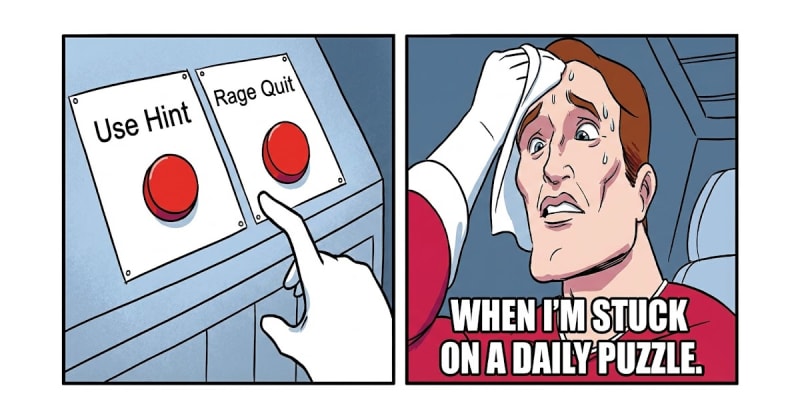 Image via Imgflip
Summary
The hint button isn’t a moral failing, it’s a design feature. Research shows hints help players stay engaged and keep learning, while quitting in frustration does neither. This guide explores when to use hints, when to skip them, and what puzzle game psychology reveals about how we actually get better at solving.
The Hint Paradox
The hint button is right there. You know it’s right there. It’s been sitting there the whole time, glowing like a lighthouse you’re trying to ignore while your mental ship runs circles in the fog.
So why does pressing it feel like defeat?
Here’s the thing about hints in daily games: they’re not cheating. They’re part of the design. Stackdown penalizes you with a lower star rating when you use them, sure, but the game still gives them to you. Connections lets you shuffle the board as many times as you want, another form of help that nobody calls cheating. Yet somehow, sliding that hint bar feels different.
Research on puzzle game hint systems shows something fascinating: players with less experience and low self-esteem rely more heavily on hints, while some players refuse them entirely because it “affects their sense of accomplishment.” The people who design these games know this. They’re not judging you for using hints. They’re trying to keep you in the game.
The Real Question Isn’t “Should I?”
It’s “What am I trying to get out of this?”
If you’re solving crosswords to learn vocabulary or improve your language skills, looking up answers isn’t just acceptable, it’s the point. One longtime crossword solver put it this way: trawling through the dictionary for unfamiliar words “implanted many new words into my mind” and made them a better solver over time. They didn’t see this as cheating; they saw it as learning.
If you’re playing Stackdown to maintain a daily routine and keep your brain engaged, getting stuck and quitting is worse than using a hint. The goal is completion and consistency, not perfection. If the hint isn’t enough, you might find yourself googling “stackdown answers today” and finding a source like the Stackdown answers page on Playlin that can help guide you to finding the answer with no spoilers to maintain the integrity of the game.
If you’re entering a competition or maintaining a streak you’re genuinely proud of, maybe the hint stays untouched. But even then, puzzle psychology research suggests that stepping away and coming back later works better than grinding through frustration.
The Designer’s Perspective
Game developers spend serious time thinking about hint systems. A good hint system gives progressive clues, just enough to nudge you forward without solving the puzzle for you. The worst ones either give too much too soon or flash “HINT AVAILABLE” repeatedly until you want to throw your phone.
Stackdown does this well. The hint slider shows you a brief description of the word you need, not the answer itself. You still have to connect the clue to the letters in front of you. It’s a nudge, not a solution.
Research from IEEE found that reminder-based hints—the ones that pop up automatically when you’re taking too long—are universally annoying. Players find them condescending. But user-controlled hints? Those “enhance the gameplay experience” because you decide when you need help.
What the Data Actually Shows
When researchers studied puzzle games, they found something counterintuitive: hint systems reduce frustration and improve player retention by making puzzles more approachable. Getting stuck and quitting means you never get better—hints keep you in the game.
When Hints Make Sense
Use a hint when:
- You’ve been stuck for more than 1-3 minutes and you’re starting to get frustrated
- The puzzle is teaching you something (like new vocabulary or pattern recognition) and you need guidance
- You’re playing for fun, not competition, and getting stuck would make you quit
- You’ve tried stepping away and coming back, and you’re still blocked
- The alternative is Googling the answer anyway
Don’t use a hint when:
- You’re in a competition where your score or rank actually matters
- You haven’t actually tried yet (looking at you, people who hint on the first word)
- Struggling through is building a skill you genuinely want to develop
- You know you’ll figure it out in a minute and you’re enjoying the challenge
The Crossword Test
Here’s a helpful framework from the crossword community: if you’re solving for pleasure, you set your own rules. The only time “cheating” definitively applies is when there’s a competition with prizes, where using outside help violates the stated rules.
For everything else? It’s your puzzle. You paid nothing (or very little) to play it. There’s no prize except the satisfaction of completion. The game resets tomorrow whether you finish or not.
One player summed it up perfectly in a forum discussion: “I’d rather use hints and have fun (that’s why they’re there!) than get stuck and quit.”
The Bottom Line
Hints are designed to keep you playing, not to judge your intelligence. Puzzle games reduce stress and improve cognitive function, but only if you actually finish them. Quitting in frustration does the opposite.
The real skill isn’t avoiding hints. It’s knowing when to use them so you stay engaged, keep learning, and come back tomorrow.
Press the button. Tomorrow’s puzzle is waiting.
Sources
- Beyond User Control: Exploring Hint System Design and Player Experience in Puzzle Games (IEEE, 2024)
- An Adaptive Hint System for Puzzle Games (IEEE)
- Stackdown Answers & Hints (Playlin)
- What Makes a Good Hint System? (Postcurious, 2019)
- Crossword Puzzle Help: Is it Cheating? (Bright Sprout, 2024)
- Cheating? (Alberich Crosswords)
- Creativity, Puzzle Games, and Brain Damage (Psychology Today, 2012)
- Evaluation of Stress and Cognition Indicators in a Puzzle Game (PMC, 2023)
- In-game hint systems (Nilsson, 2024)
Have a daily web game or one in the works? Come across something news-worthy or delightfully playable? Reach out, we love highlighting inventive creators and playful ideas from across the web.